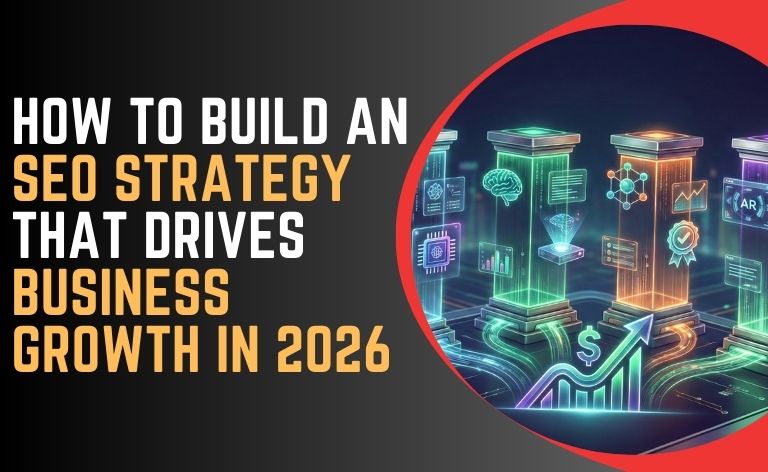
How to Build an SEO Strategy That Drives Business Growth in 2026

How to Build an SEO Strategy That Drives Business Growth in 2026

Are you investing in SEO but not seeing qualified leads or sales? Is your website ranking for keywords that don’t convert? Are AI search, voice search, and Google’s new algorithms making your old SEO playbook obsolete?


In 2026, SEO is no longer about traffic alone. A modern SEO strategy for business growth must be tied directly to revenue, lead quality, customer journeys, and long-term scalability. Businesses that continue using outdated SEO methods will struggle. Those who adopt a data-driven, AI-ready, ROI-focused SEO strategy will dominate search — and markets.


Let’s break down how to build a future SEO strategy in 2026 that actually grows your business.

Why SEO Strategy in 2026 Is Fundamentally Different

Search has changed — and so has buyer behavior.


In 2026, your SEO strategy must work across:

  • Google Search
  • AI answers (LLM SEO optimisation)
  • Voice and conversational search
  • Local intent (Google Business Profile)
  • B2B and high-consideration journeys


A long-term SEO strategy today is not a channel strategy — it’s a business growth system.


Key shifts shaping SEO plan 2026:

  • AI-powered search summaries
  • Zero-click results
  • Conversational and intent-based queries
  • Content evaluated for trust, authority, and usefulness
  • Strong integration between SEO, PPC, and CRO

Step 1: Define Business Outcomes Before SEO Tactics

A professional SEO strategy for companies starts with business clarity, not keywords.


Before planning SEO, define:

  • Which products/services must generate leads
  • Revenue targets per channel
  • Ideal customer profiles (ICP)
  • Sales cycle length (B2B vs B2C)
  • Regions (local, national, international SEO)


This ensures your SEO roadmap for businesses supports:

  • Lead generation
  • Sales enablement
  • Brand authority
  • Market expansion


This is where most startups and even enterprises fail — they optimize pages, not business outcomes.

Step 2: Build a Data-Driven SEO Strategy Framework

In 2026, assumptions kill growth. Data drives decisions.


A data-driven SEO strategy includes:

  • Search intent mapping (informational vs commercial)
  • Keyword-to-revenue alignment
  • Funnel-based content planning
  • Competitor gap analysis
  • SEO + PPC keyword overlap analysis


This framework helps you:

  • Increase qualified traffic
  • Reduce wasted SEO effort
  • Improve conversion rates
  • Build a performance-based SEO strategy

Step 3: SEO Strategy for AI, Voice & Conversational Search

Search is becoming conversational — and your SEO must adapt.


A future-ready AI search optimization strategy focuses on:

  • Question-based content
  • Natural language optimisation
  • Structured data and schema
  • Topical authority clusters
  • LLM-friendly formatting


This is critical for:

  • SEO for voice and AI search
  • SEO for conversational search
  • Visibility in AI-generated answers


Businesses ignoring this will lose visibility — even if they rank traditionally.

Step 4: Technical SEO as the Growth Foundation

No SEO growth is possible without strong technical fundamentals.


A technical SEO agency focuses on:

  • Core Web Vitals
  • Site speed and UX
  • Crawlability and indexing
  • Mobile-first optimisation
  • Secure and scalable architecture


Technical SEO is not optional in 2026 — it’s the base of every scalable SEO strategy.

Step 5: Content That Supports Sales, Not Just Traffic

Content must move users closer to conversion.


A business growth SEO strategy includes:

  • BOFU (bottom-of-funnel) service pages
  • Comparison and decision-stage content
  • Case studies and proof-driven pages
  • Industry-specific landing pages
  • Ecommerce SEO for revenue-focused categories


This is how SEO starts supporting:

  • SEO strategy to increase leads
  • SEO strategy to increase sales
  • SEO for revenue growth

Step 6: Integrated SEO Strategy (SEO + PPC + CRO)

In 2026, siloed marketing fails.


A modern integrated SEO strategy connects:

  • SEO keyword insights → PPC performance
  • PPC data → SEO prioritisation
  • SEO traffic → CRO and landing page optimisation


This integration is why businesses now prefer SEO and PPC agencies instead of isolated vendors.
Step 6: Plan a Quarterly Digital Marketing Roadmap

In 2026, siloed marketing fails.


A modern integrated SEO strategy connects:

  • SEO keyword insights → PPC performance
  • PPC data → SEO prioritisation
  • SEO traffic → CRO and landing page optimisation


This integration is why businesses now prefer SEO and PPC agencies instead of isolated vendors.
Business-Focused Traditional SEO vs Modern SEO Strategy 2026

Aspect

Old SEO Approach

SEO Strategy 2026

Goal

Rankings

Business growth

Keywords

High volume

High intent

Content

Blogs only

Full funnel

AI Search

Ignored

Fully optimised

Measurement

Traffic

ROI & revenue

Scalability

Limited

Enterprise-ready

SEO Strategy for Startups, SMEs & Enterprises

  • SEO strategy for startups: Focus on fast traction, niche authority, local SEO, and early ROI
  • SEO for small businesses: Local SEO, Google Business Profile, service keywords
  • Enterprise SEO strategy: Scalable architecture, international SEO services, automation


Each stage needs a different SEO planning for business growth approach.

Why Businesses Choose ThinkNEXT Technologies for SEO Strategy 2026

Businesses don’t need “SEO packages.” They need growth systems. ThinkNEXT Technologies works as a strategic SEO consulting partner, not just an execution agency.


Why decision-makers choose ThinkNEXT:

  • ROI-focused SEO strategy
  • AI and LLM SEO optimisation expertise
  • SEO + PPC + CRO integration
  • Local, national, and international SEO services
  • Proven experience as a best SEO agency in Chandigarh


SEO here is built to support sales teams, revenue goals, and long-term brand authority.

Final Thoughts: SEO Strategy 2026 Is a Growth Decision, Not a Marketing Task

In 2026, SEO is no longer optional — and it’s no longer tactical.


A future SEO strategy must:

  • Support business goals
  • Adapt to AI-driven search
  • Scale with growth
  • Deliver measurable ROI


If your current SEO isn’t contributing to leads, sales, or market expansion, it’s time to rethink the strategy — not the budget.

Conclusion: Why Choosing the Right SEO-Led Digital Marketing Agency Matters in 2026

In 2026, SEO cannot work in isolation. Businesses that win in search are partnering with a best digital marketing agency in chandigarh that operates also as a strategic SEO agency, not just an execution vendor. A modern SEO strategy must connect search visibility, lead quality, conversion optimisation, paid media, and long-term brand growth into one unified system.


This is where an SEO-focused digital marketing company makes the difference. Instead of chasing rankings, such agencies align SEO with business KPIs, sales pipelines, and revenue goals—while preparing your brand for AI search, voice queries, and evolving buyer behaviour.


For businesses seeking an integrated, ROI-driven approach, ThinkNEXT Technologies brings together SEO strategy, PPC, content, and conversion optimization under one growth framework—designed for 2026 and beyond.


Contact Details 

ThinkNEXT Technologies Private Limited

Address: SCF 113, Phase 11, Sector 65, Mohali, Punjab

Phone: 7837402000, 7837403000

Email: info@thinknext.co.in

Website: https://www.thinknext.co.in/


FAQs – SEO Strategy 2026

Q1. What is SEO strategy 2026?
Ans. SEO strategy 2026 focuses on AI search, conversational queries, business outcomes, and long-term revenue growth instead of just rankings.


Q2. How is SEO different in 2026 compared to earlier years?
Ans. SEO now prioritises intent, AI optimisation, content usefulness, and ROI rather than keyword stuffing or backlinks alone.


Q3. Can SEO really drive business growth?
Ans. Yes. A well-planned SEO strategy for business growth increases qualified leads, sales, and brand authority over time.


Q4. Is SEO still relevant with AI search?
Ans. More than ever. SEO now determines how your business appears in AI-generated answers.


Q5. How long does SEO take to show ROI?
Ans. With a performance-based SEO strategy, early traction appears in 3–6 months, with compounding returns long-term.


Q6. Do startups need a different SEO strategy?
Ans. Yes. SEO for startups focuses on faster wins, niche authority, and scalable growth.


Q7. What role does technical SEO play in 2026?
Ans. It’s fundamental. Without strong technical SEO, content and rankings fail.


Q8. Should SEO and PPC work together?
Ans. Absolutely. Integrated SEO and PPC strategies maximise ROI and reduce wasted spend.


Q9. Is local SEO still important in 2026?
Ans. Yes, especially for service businesses using Google Business Profile optimisation.


Q10. Who should handle SEO strategy for businesses?
Ans. A professional SEO consulting partner like ThinkNEXT Technologies that aligns SEO with revenue, not vanity metrics.

Enquiry Form